
Gold has always been one of the most preferred forms of wealth in India. Whether it is jewellery, coins, bars, or digital gold, Indians hold gold for cultural, festive, and investment purposes. However, many gold owners are unaware that selling gold in India comes with tax implications, especially in the form of capital gains tax. Understanding these rules is crucial to ensure compliance with the Income Tax Act, 1961.
This guide explains the tax rules on selling gold in India, how capital gains are calculated, exemptions, and practical tips for taxpayers.
1. What is Capital Gains on Gold?
When you sell gold for more than its purchase price, the profit is considered a capital gain. The taxation depends on how long you have held the gold and its type. Gold is classified as a capital asset under Indian tax law, similar to real estate or stocks.
2. Short-Term vs Long-Term Capital Gains
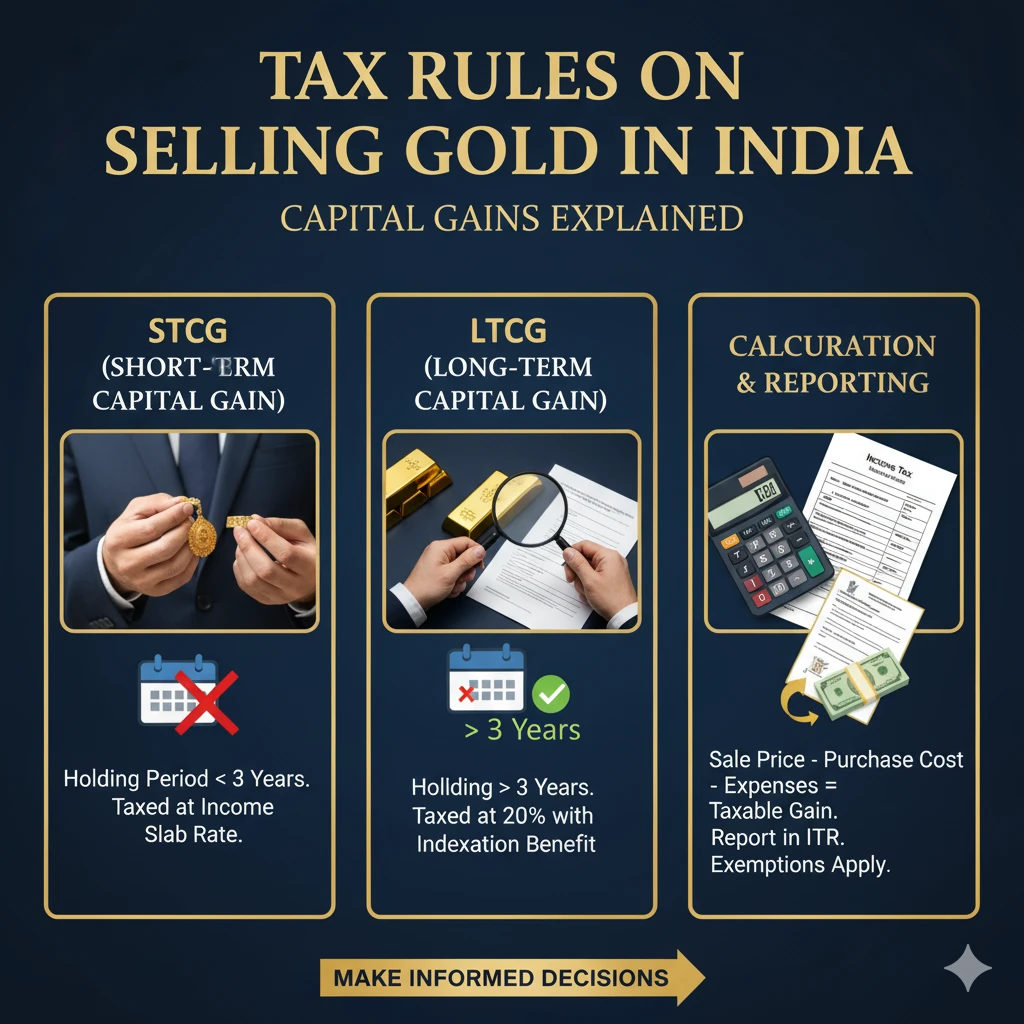
Capital gains on gold are categorized based on the holding period:
| Holding Period | Type of Capital Gain | Tax Rate / Rules |
|---|---|---|
| Less than 3 years | Short-Term Capital Gains (STCG) | Added to total income and taxed as per your income slab rate |
| More than 3 years | Long-Term Capital Gains (LTCG) | 20% with indexation (inflation adjustment) |
Example:
- Purchase: 10 grams of 22K gold for ₹5 lakh
- Sold after 2 years for ₹6 lakh → Short-term capital gain = ₹1 lakh, taxed as per income slab
- Sold after 4 years → Long-term capital gain = ₹1 lakh (after indexation, may reduce slightly)
3. How to Calculate Capital Gains on Gold
A. Cost of Acquisition
Purchase Price: The price paid for gold, including GST, is considered the cost of acquisition.
Inherited Gold: If inherited before April 1, 2001, the fair market value (FMV) as of that date is used for LTCG calculation.
B. Sale Price
The total amount received when selling the gold, excluding making charges, is considered the sale price.
C. Indexation (For LTCG)
Indexation accounts for inflation and adjusts the purchase price to reduce taxable gains. The CII (Cost Inflation Index) is used for this calculation.
Example Calculation (LTCG):
- Bought gold in 2015 for ₹4 lakh
- Sold in 2025 for ₹6 lakh
- Indexed cost = ₹5 lakh (after applying CII)
- Taxable LTCG = ₹6 lakh – ₹5 lakh = ₹1 lakh
- Tax payable @20% = ₹20,000
4. Exemptions on Selling Gold
Certain sales are exempt from capital gains tax:
- Gold received as a gift from relatives: No tax is levied if sold, as the original acquisition cost is considered inherited.
- Wedding Gifts: Gold received on your wedding is fully exempt under Indian tax law.
- Gold held under Sovereign Gold Bonds (SGBs): Capital gains on redemption of SGBs after maturity are exempt.
5. GST Consideration
When selling newly purchased gold jewellery, GST paid during purchase does not reduce capital gains tax liability. GST is applicable only at the time of purchase and does not affect resale value or tax calculation.
6. Reporting Sale of Gold in ITR
Sale proceeds of gold must be declared under "Capital Gains" in your Income Tax Return (ITR).
- Short-term gains: Add to your total income in ITR Form 1 or 2 depending on your income.
- Long-term gains: Report separately under Schedule CG.
Tip: Keep purchase bills, invoices, and gift deeds to substantiate the cost of acquisition and holding period.
7. Practical Tips for Gold Sellers
- Maintain Documentation: Keep all bills, receipts, and jewellery certificates for proof of purchase.
- Check Holding Period: Decide whether your sale qualifies as STCG or LTCG.
- Plan for Tax Payment: If the gains are substantial, consider paying advance tax to avoid penalties.
- Invest in Tax-Saving Options: LTCG on other assets allows exemptions under Section 54EC, though not directly applicable to gold, proper planning can help manage overall capital gains tax.
- Digital Gold: Selling digital gold works similarly, with gains calculated based on purchase and sale price.
8. Common Misconceptions
- "Gold sold from inherited jewellery is fully exempt from tax." ❌ Only if it is inherited, cost is considered FMV; gains may still apply if sold above FMV.
- "GST paid at purchase reduces capital gains." ❌ No, GST does not affect capital gains calculation.
- "All jewellery sales are tax-free." ❌ Only exempt gifts and SGB redemption are exempt; others are taxable.
Get Expert Gold Valuation & Tax Guidance
Calculate your capital gains accurately and ensure tax compliance. Contact AuFluence for professional gold assessment.
Book Free ConsultationConclusion
Selling gold in India is simple yet requires attention to tax rules. Capital gains tax applies based on the holding period: short-term for less than 3 years and long-term for over 3 years with indexation. Proper documentation of purchase, sale, and gifts is crucial to ensure compliance with Income Tax laws.
By understanding these rules, Indian taxpayers can enjoy the financial benefits of gold investments without falling into legal or tax complications. Always plan your gold sales with capital gains, exemptions, and documentation in mind to optimize tax efficiency.