
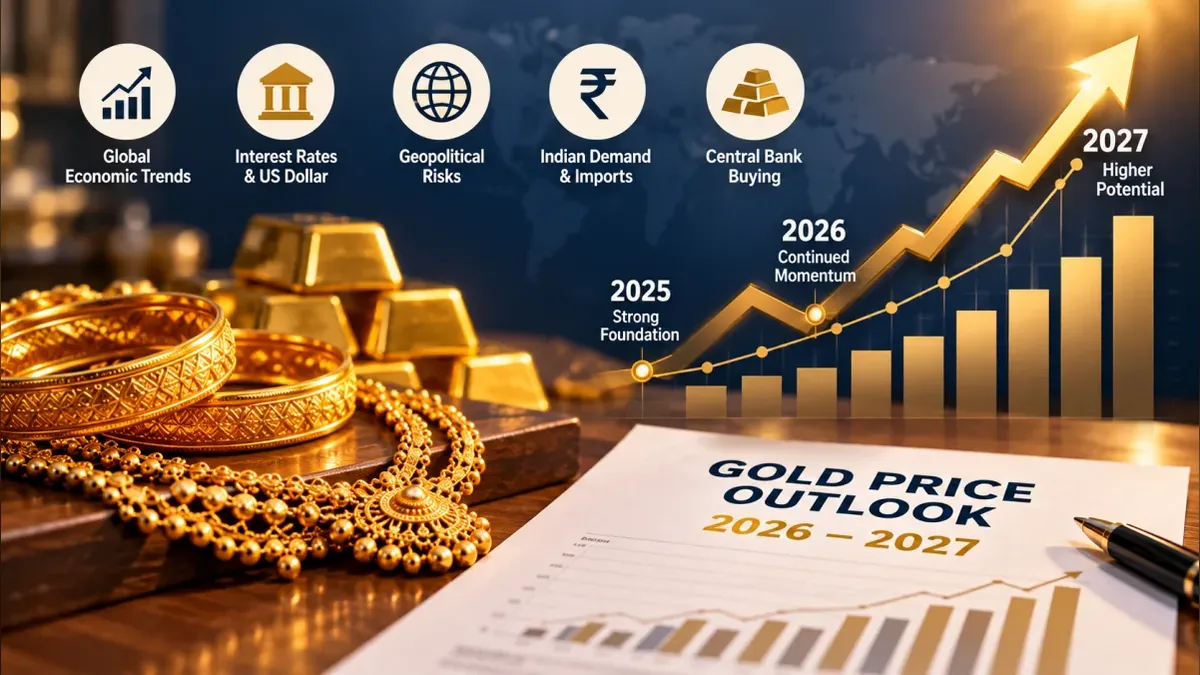
Gold has had an extraordinary run. Indian prices set new records in early 2026, pulled back, and still sit far above where they were two years ago. If you're thinking about selling old gold, holding on, or buying for a wedding or festival, the question is the same: where do prices go from here?
No one can predict gold prices reliably, and you should be wary of anyone who says they can. What we can do is look at where prices stand, what has been driving them, and which factors to watch through 2026 and 2027.
Where Gold Prices Stand Now
In mid-October 2026, 24K gold in India is trading at around ₹1.5 lakh per 10 grams, roughly ₹15,000 per gram. You can check today's live 24K, 22K and 18K rate in Panvel.
That's below the peak earlier this year. According to the World Gold Council, Indian prices hit a record of ₹1,75,231 per 10 grams during the first quarter of 2026, and international prices touched US$5,405 an ounce, before correcting by about 15%. Even after that fall, prices remain well above their levels of a year ago: the Council reported Indian prices up 81% year on year in that quarter.
What Has Been Driving Prices
- Central bank buying. Central banks around the world have been buying gold heavily to diversify their reserves. This steady official demand has been one of the biggest supports for prices.
- Geopolitical tension. Conflict and uncertainty, including in West Asia, push investors towards gold as a safe asset.
- A higher import duty in India. On 13 May 2026 the government raised the import duty on gold from 6% to 15%, made up of a 10% basic customs duty and a 5% Agriculture Infrastructure and Development Cess. A higher duty raises the cost of gold landed in India, which feeds into domestic prices.
- The rupee. Gold is priced internationally in US dollars, so when the rupee weakens, Indian gold prices rise even if global prices don't.
- Investment demand. Indians are increasingly buying gold as an investment rather than as jewellery. In early 2026 investment made up nearly 70% of India's gold demand, with record buying through coins, bars and gold ETFs.
What to Watch in 2026 and 2027
- US interest rates and bond yields. Gold pays no interest, so when interest rates and bond yields rise, gold tends to come under pressure; when they fall, gold usually benefits. Gold fell sharply in September 2026 as US yields climbed. Watch what the US Federal Reserve does next.
- Central bank demand. If central banks keep buying at recent levels, it gives prices a strong floor. A slowdown would remove an important support.
- The rupee-dollar exchange rate. A weaker rupee pushes Indian gold prices up, and a stronger one pulls them down.
- Import duty changes. Any cut or further rise in the 15% duty would move Indian prices directly.
- Geopolitics. Escalating tensions tend to lift gold; easing tensions can take some of the shine off.
- Indian demand. Wedding and festival seasons and the monsoon all affect local demand. The World Gold Council expects investment demand to stay firm, while jewellery demand may stay under pressure at today's high prices.
What the Forecasts Say
Several major banks have published forecasts that put gold above today's levels by the end of 2026 and into 2027. But those forecasts differ widely, and they've been revised repeatedly as interest-rate expectations have shifted. Treat any single forecast as one view, not a promise. Gold can and does fall, as the drop of around 15% from the early-2026 peak shows.
What This Means If You're Selling Gold
- Don't try to time the exact peak. Prices are still near historic highs. Waiting for a little more could mean selling for less if prices fall.
- Sell what you don't need, when you need the money. If you have old or broken jewellery you'll never wear, today's prices are high by any historical standard.
- Get an accurate valuation. At high prices, small differences in purity or weight matter more. Insist on XRF testing in front of you. Read how gold buyers calculate your price.
- If you have a gold loan, higher prices mean your pledged gold may now be worth well over what you owe. Selling it to close the loan could leave a sizeable balance for you. See how selling pledged gold works, or compare renewing your loan versus selling.
What This Means If You're Buying Gold
- Spreading purchases over time can reduce the risk of buying at a short-term high.
- The higher import duty raises the cost of new gold in India, so compare prices carefully, and remember GST and making charges on jewellery.
- Always buy BIS-hallmarked jewellery and keep your bills: they make it easier to sell later.
Thinking of Selling at Today's Prices?
Get a transparent valuation in Old Panvel, with XRF purity testing in front of you, exact weighing and instant bank transfer, or book a doorstep visit anywhere in Panvel and Navi Mumbai.
Check Today's Gold RateOr call us on +91 8779113535.
Conclusion
Gold enters 2026–27 well above its levels of a year ago but below its early-2026 peak. Interest rates, central bank buying, the rupee, India's import duty and global tensions will decide its direction, and none of those can be predicted with certainty. Rather than trying to time the market, make your decision based on your own needs, and make sure you get an accurate, transparent price when you do.
This article is general information, not investment advice. Gold prices can go down as well as up. Figures are from the World Gold Council and published reports as of October 2026.